Friday Flyer - December 12, 2025
This is the last Friday Flyer of 2025. Savor it with some eggnog if you can.
Spotlight on the Oklahoma QuarkNet Centers
Oklahoma has two QuarkNet centers - The University of Oklahoma (OU) and Oklahoma State University (OSU) - that work in tandem. Teachers are effectively members of both centers simultaneously, that alternate each year in hosting the summer workshop. This past summer, the group met at OU to work on cosmic ray studies with fellow Marybeth Senser and Ken, as well as both mentors: John Stupak from OU and Joe Haley from OSU. They did a variety of activities with Cosmic Ray Muon Detectors, including some troubleshooting, and with the Cosmic Ray e-Lab. Along the way, the teachers were treated to talks on particle physics, cosmic rays, and machine learning.
Each year, Joe Haley hosts multiple ATLAS International Masterclasses at OSU and 2025 was no exception: OSU had three masterclasses on three different days in IMC 2025 to host students from 40 high schools across the state.
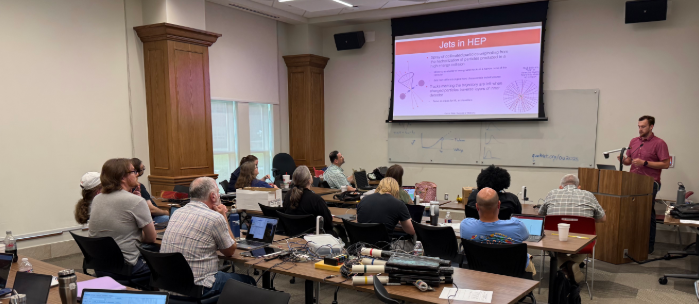
and machine learning. Note the fine-looking CRMD in the foreground.

News from QuarkNet Central
International Masterclasses 2026: Fermilab-based International Masterclasses will be held March 1-28, 2026. Registration is still open until Friday December 19! (After that, you can still register by email.) We have an online form for Fermilab masterclasses to be filled out by a single organizer of each masterclass. For all the news, go to the latest IMC circular.
Perimeter Institute offers the EinsteinPlus Workshop for Teachers: Applications are open for this five day workshop in July 2026. Learn more!
Beamline for Schools (BL4S) 2026: Pre-registration is open for BL4S 2026. Follow this link to learn more about this competition, and to pre-register.
Congratulations to the 2025 PhysTEC Teacher of the Year awardees. At least two QuarkNetters made the list, including Jeremy Smith (Johns Hopkins center) and Michael Smith (Brookhaven/Stony Brook center). Way to go!
Update on the Cosmic Ray e-Lab: The Cosmic Ray e-Lab is back up and running, and detector teams should once again be able to upload data. Please give it a try, and let the QuarkNet staff know if you encounter any issues.
Got some time Monday morning? How about a webinar on "Quantum Views" by Alain Aspect and William D. Phillips, Nobel Laureates in Physics with your 8 am ET cup of coffee (or first period class)?
Physics Experiment Roundup
Let's start with CERN. CERN Bulletin reports a breakthrough in producing antimatter and provides the latest LHC accelerator report (spoiler: going strong). Phys.org posts another breakthrough, H → μμ, as well as a deep LHC dive into quantum reality.
Speaking of quantum reality, here is a new test of the single slit question explained in APS Physics.
Neutrino world also beckons. IceCube is narrowing in on where neutrinos come from and Phys.org has this and this on latest results about sterile neutrinos.
Dark Matter also calls. Are we closer to direct observation? Brighter Side News says maybe. Science Daily says the same. Interactions does not mention that but does explain improvements in the LZ Dark Matter Experiment.
Let's wrap with an unintentional cosmic ray result, reported in Space.com.
Resources
Let's begin with a nice resource by Fermilab physicist and QuarkNet friend Chris Quigg: an insightful article in APS Physics on the origin of quark and lepton mass. From Perimeter Institute, we have more insights, this time on AI and black holes. Phys.org reveals a new approach to quantum physics and gravity and Max Planck Institute offers a primer on particle physics for us and our curious students.
Here's a nice resource for the classroom from The Physics Teacher: a hands-on Gauss's Law activity.
APS Physics also gets into some interesting issues for physics communication and education. Scientists wonder about AI and peer review and still need basic education in writing.
Just for Fun
It is that time of year again! Yes, it is time for great films and videos as well as reflections on the holidays ahead. Let's get past old standbys like It's a Wonderful Life or Miracle on 34th Street and its many remakes, and get to the great stuff. How about the QN favorite Santa Claus Conquers the Martians or the MST3K version of same? Speaking of Santa, we have a lot of physics there: just ask Charlie and Neal in Time Travel Nexus or consult this short video. Even ABC News weighs in on the Santa paradox.
We at QuarkNet wish everyone very Happy Holidays and the very best for 2026!
QuarkNet Staff
Mark Adams: markadams74@gmail.com
Ken Cecire: kcecire@nd.edu
Spencer Pasero: spasero@fnal.gov
Shane Wood: swood5@nd.edu