

Friday Flyer - January 16, 2026
Spotlight on the Black Hills State / SURF QuarkNet Center
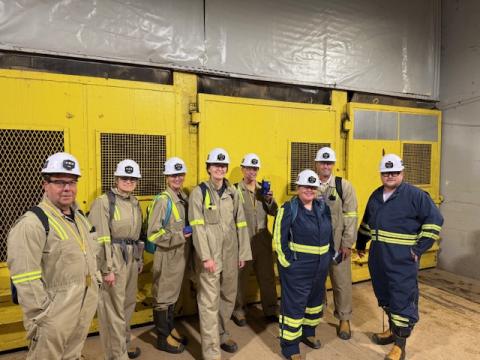
The Black Hills State University / Sanford Underground Research Facility (SURF) QuarkNet Center hosted a multi-day summer workshop in 2025 that immersed teachers in particle physics research both at the surface, and a mile underground. Participants first explored muon science through Data Activities Portfolio investigations such as Signal & Noise: Cosmic Ray Muons, Mean Muon Lifetime, and How Speedy Are These Muons? Teachers developed brief “elevator speeches” to articulate what students do in each activity, how it connects to muon physics, and how it fits into their own classrooms.
Participants also worked with Cosmic Ray Muon Detectors and Cosmic Watches, collecting and analyzing data at the surface and 4,850 feet underground at SURF’s Davis Campus. The experience culminated in teacher-led research posters, classroom implementation planning, and participation in 2025 Neutrino Day in Lead, South Dakota, connecting teachers with the broader community.
Image

News from QuarkNet Central
International Masterclasses 2026: Fermilab-based International Masterclasses will be held March 1-28, 2026. The registration link has closed, however you can email Ken to register by email. For all the latest IMC news, see the IMC circular from January 9 and from today with an important update CMS masterclasses.
Perimeter Institute offers the EinsteinPlus Workshop for Teachers: Applications are open for this five-day workshop in July 2026. Learn more!
Beamline for Schools (BL4S) 2026: Proposal submission is open for BL4S 2026. Follow this link to learn more about this competition, to pre-register, or to submit your proposal.
Congratulations to Puerto Rico QuarkNet teacher and Coding fellow Danelix Cordero for receiving the Excellence in Computing Education Award from the National Center for Women and Technology Organization (NCWIT) in 2025. Way to go!
Mentors and Lead Teachers: The QuarkNet RFP form is now available so that you can start to crystallize your ideas and request the resources you may need for your 2026 QuarkNet program. Please complete this form by January 30, 2026.
Physics Experiment Roundup
We kick off this week’s Roundup with 2025 highlights from both Fermilab and CERN. AAAS Science named its 2025 Breakthrough of the Year, and Physics World compiled its Top 10 Breakthroughs of 2025. OK...one more list of highlights from 2025: Physics Magaine editors' favorite articles from the year.
Phys.org reports the discovery of a new state of matter in a quantum material, while Space.com covers the ongoing search for dark matter through “ghost particles” in galaxy clusters. Symmetry highlights muons as “Emblems of Discovery” in particle physics.
Fermilab updates include breakthroughs in AI, where researchers supercharged neural networks to revolutionize particle physics, the complex multi-layered approach to containing thousands of tons of liquid argon for DUNE, and the completion of a laser lab for the world’s largest vertical atom interferometer.
At CERN, knowledge-sharing efforts are advancing science and society through work on next-generation radionuclides for cancer therapy and superconductors with broad potential applications.
Resources
This month’s The Physics Teacher features several free-access articles for classroom inspiration and professional reading. Highlights include “The Boiling-Frog Problem of Physics Education,” which examines how AI is reshaping physics teaching; “Surviving a Syrup Tsunami,” which uses a real-world industrial accident to examine fluid dynamics and safety considerations; and “Hawking for Beginners.”
From the Interactions Collaboration: Cast your vote for the best big physics photo of 2025.
MinutePhysics brings us an argument that the moon is a planet. (What?!) Also...the weird orbit of the moon.
We end the Resources section with this nice Introduction to Particle Physics website from the Max Planck Society.
Just for Fun
Want to bend your brain? Check out FeynCraft, a game where you build Feynman diagrams like a particle physicist. Drag, drop, and discover which interactions make sense and which don’t! (Read more about FeynCraft from arXiv.)
Dive into the Be Smart YouTube channel, hosted by science communicator Dr. Joe Hanson. There you will find all sorts of videos that will "make you smart," including why Mars used to be blue and one on measuring distances in the universe.
We end with the XKCD Corner: High Altitude Cooking Instructions, and Planetary Alignment.
QuarkNet Staff
Mark Adams: markadams74@gmail.com
Ken Cecire: kcecire@nd.edu
Spencer Pasero: spasero@fnal.gov
Shane Wood: swood5@nd.edu