
Friday Flyer - March 20, 2026
Spotlight on the University of Minnesota QuarkNet Center
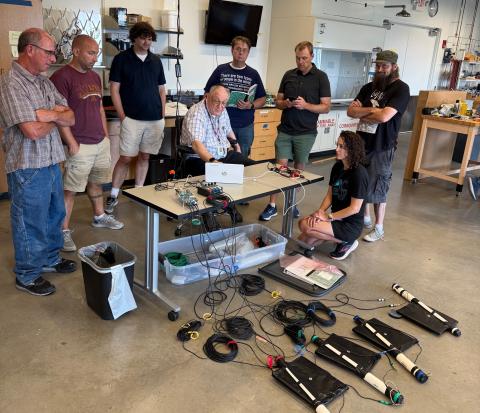
In early 2025, the U of M center partnered with QuarkNet staff to host a one-day Physics Education Forum for about a dozen Minneapolis - St. Paul area physics teachers, many of whom were new to QuarkNet. The primary goal was to identify the successes and hurdles teachers face, ranging from curriculum alignment to resource accessibility, helping to ensure that QuarkNet programming remains supportive and relevant to the current educational landscape. The center hosted a NOvA masterclasses in April, giving participating students a chance to dive into the world of neutrino oscillations by analyzing real data from the NOvA experiment’s detectors and using Python for event analysis. Beyond the data, students experienced a hands-on exercise using photolithography and were able to tour the clean room at the U of M's Physics and Nanotechnology building.
During the summer workshop, QuarkNet fellow Mike Plucinski guided teachers through machine learning activities focused on linear regression and decision trees, equipping them with tools to bring these computational concepts into their classrooms. Cosmic Ray Fellow Nate Unterman led a portion of the workshop featuring extensive work with Cosmic Watches and QuarkNet Cosmic Ray Muon Detectors (CRMD). Participants also attended talks from physics faculty on the muon spectrometer and dark matter. The ever-popular Share-A-Thon provided an opportunity for teachers to exchange resources, classroom activities, and practical teaching strategies.
Image

News from QuarkNet Central
International Masterclasses 2026: Fermilab-based International Masterclasses are ongoing through March, with an additional two-day "masterclass island" in April. For general information, go the Masterclass Library and, for all the latest masterclass news, see the most recent IMC circular.
Coding Camp 1 will be held virtually via Zoom from June 29–July 3. During this week, teachers learn to code in Python, analyze authentic physics data, and build pathways for bringing computational thinking into their classrooms. Applications for Coding Camp 1 are due March 27, 2026. For more information and application details, visit the Camp 1 page or contact Coding fellows Tracie Schroeder (bravesearth@gmail.com) or Carol Burns (burnscarol2020@gmail.com).
Student Success! It’s always rewarding to celebrate the remarkable paths our students take after leaving our classrooms. QuarkNet teacher and LHC Fellow Michael Wadness recently shared exciting news from former student Joseph Farah, whose research was featured as the cover story of the March 2026 issue of Nature journal. His work on general relativity and the “heartbeat” of dying stars has drawn widespread attention, including coverage from Scientific American and Reuters, and he will present a public talk on his findings later this month in Santa Barbara, California. As he prepares to defend his dissertation in high energy astrophysics this May, Joseph has already secured an exciting next step: he will join the Miller Institute for Basic Research in Science at University of California, Berkeley as a Miller Fellow this fall.
Save the date CMS Open Data 28-30 July
Physics Experiment Roundup
From CERN: The LHCb Collaboration has discovered a new proton-like particle composed of two charm quarks and one down quark, an exotic configuration that is significantly heavier than a proton and offers new insight into how quarks bind together. Meanwhile, the ATLAS Collaboration has pushed the search for supersymmetry further than ever, using advanced machine learning techniques to probe for elusive particles such as higgsinos. While no evidence has yet been found, the results place some of the strongest constraints to date on supersymmetric models. Looking ahead, teams at the Large Hadron Collider are preparing for a short but intense 2026 run, carefully designed to maximize physics output during this final stretch before the High-Luminosity LHC upgrades.
From Fermilab: The FAST/IOTA accelerator test facility has achieved a major milestone by successfully accelerating and storing its first proton beams, opening new avenues for research in next generation accelerator technologies and high-intensity beams. Next we take a look at Fermilab’s role in the national AI Genesis mission, where artificial intelligence is being integrated into accelerator science and future experiments. Lastly, researchers are preparing a new generation of dark matter searches that aim to probe previously unexplored regions of parameter space.
Resources
The March issue of The Physics Teacher is out and we feature a few of the freely-available articles here. One article explores how nanoscale structures lead to macroscopic effects, helping students connect atomic-scale physics to real world materials. Another investigation examines the oscillation of a ball on a concave surface, providing an accessible way to study damping, friction, and harmonic motion through simple experimental setups. An article on computational assessment in physics encourages educators to think beyond traditional problem solving in physics and consider how to evaluate students’ coding and modeling skills. A lesson on everyday radioactivity engages students with the idea that natural radiation is all around us. Finally, “Liberty on a Pedestal" Fermi problem, and its accompanying solutions.
As many of you know, last Saturday was Pi Day. Perimeter Institute (PI) explores how Pi is used at PI. (See Just for Fun for more pie.) Also from PI: "Three Ways That Physicists Make Their Own Luck" and "Winding Paths in Science Lead to Fascinating STEM Careers."
Lastly, "Is Quantum Mechanics Stopping Aliens From Contacting Us?" from MinutePhysics.
Just for Fun
Continuing on the Pi Day theme from above....Find your Birthday in Pi. Some pie recipes from PI to celebrate (belated at this point) Pi Day. Scientific American reminds us that "all pies are filled with science" (scroll down for yet another recipe).
From pi to pie to movies. APS News takes a look back at some of the science that 2001: A Space Odyssey got right. Of course, there are many movies that get the science wrong. HowStuffWorks has compiled a list of 13 such movies. Even Reader's Digest (hmm) pipes in with a list of 10. Symmetry explores the topic as well.
QuarkNet Staff
Mark Adams: markadams74@gmail.com
Ken Cecire: kcecire@nd.edu
Spencer Pasero: spasero@fnal.gov
Shane Wood: swood5@nd.edu