
Friday Flyer - March 6, 2026
Spotlight on the University of Puerto Rico QuarkNet Center
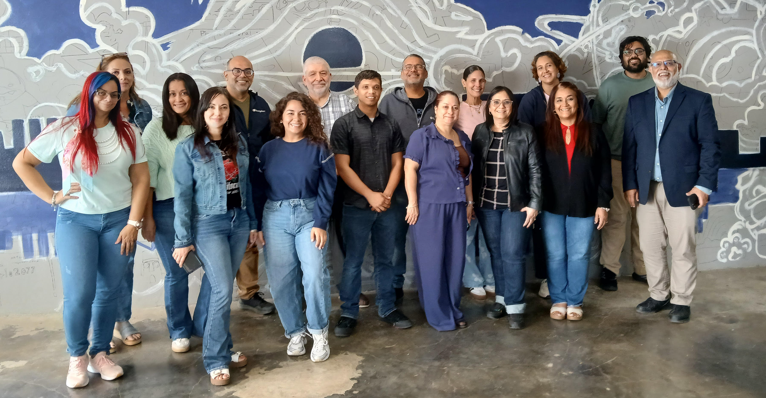
The QuarkNet center at the University of Puerto Rico Mayaguez has a far reach on a small island. Mayaguez is in the extreme west of Puerto Rico, yet teachers come not only from that area but also from Ponce (an hour away), San Juan (two hours away) and even Fajorado in the extreme northeast (three hours away). Most activity is during the academic year, with a fall workshop and winter or spring masterclass orientation and masterclass in March. In addition, IRIS-HEP coding workshops can occur any time of the year in Mayaguez or elsewhere. All of these workshops are one-day events.
This past November, the fall workshop was on the Photoelectric Effect and Electron Properties. Ten teachers conducted experiments on the photoelectric effect, the charge-to-mass ratio of the electron, and length measurement through diffraction. The facilitators included graduate students as well as Dr. Jose R. Lopez, Dr. Armando Rua, and QuarkNet mentors Professor Daniel H. Gutiérrez, and Dr. Suhdir Malik, all from the Physics Department. Last month (actually, last week), UPRM had its masterclass orientation workshop, with mentor Daniel Gutierrez and Ken facilitating. This was a pretty intense workshop as UPRM had been doing MINERvA masterclasses for the past several years, but was now switching back to CMS after a long hiatus. Dr. Malik added a presentation on CMS research at UPRM. Their masterclass will be on March 14.

News from QuarkNet Central
International Masterclasses 2026: Fermilab-based International Masterclasses are ongoing through March, with an additional two-day "masterclass island" in April. For general information, go the the Masterclass Library and, for all the latest masterclass news, see the February 27 IMC circular.
Beamline for Schools (BL4S) 2026: Proposal submission is open until March 13 for BL4S 2026. One week left! Students should follow this link to learn more about this competition or to submit a proposal.
Data Camp and Coding Camp 1: Check out the Spotlight section from the Friday Flyer last week for information about these camps, including links to applications.
Physics Experiment Roundup
Neutrinos are a riddle wrapped in a mystery inside an enigma, but after almost dozen years of running, the NOvA experiment is giving us a map, according to Phys.Org. The next clues are likely to come from DUNE. For that to work, Fermilab Frontiers informs us that liquid argon has to be kept cold a mile down. Same source: the Fermilab Mu2e experiment is closer to a start. The results just might be exciting.
Over at the LHC, we are always interested in more collisions. We also want to learn more about those collisions: in the CERN Bulletin we learn that machine learning will help. And out in space, we get results from the Dark Energy Survey, as reported in Astronomy and APS Physics, which informs us that exoplanets are telling us about how planets form.
Resources
It's Super Computing Friday! (It is?) (Well, it is now.) APS Physics starts us with a not-necessarily-home project to build an open source quantum computer. The kids'll love it. Fermilab Frontiers points us to work on scalable quantum computers and Point-Cinq gives us a blog post followed by another blog post on an advanced computing hack-a-thon for CMS. Follow all of that with an article in The Physics Teacher about assessment of computation in physics. That's a lot of computing.
Just for Fun
Is this fun? We have a non-exhaustive particle physics experiments crossword of unknown accuracy. How many experiments can you name? We haven't done one of these in a while! Want more? How about this one from 2023?
How's this? Memes. And more memes. And one xkcd.
QuarkNet Staff
Mark Adams: markadams74@gmail.com
Ken Cecire: kcecire@nd.edu
Spencer Pasero: spasero@fnal.gov
Shane Wood: swood5@nd.edu