
Friday Flyer - May 1, 2026
Spotlight on the Southern Methodist University QuarkNet Center
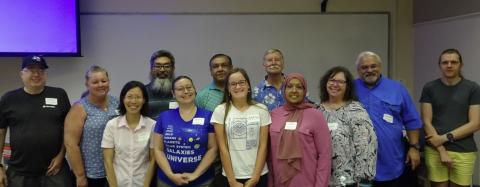
The SMU Physics Department hosted its 26th annual QuarkNet Workshop from July 15-17, 2025. Organized by Prof. Heidi Wu, the three-day event brought together nine teachers from the Dallas-Fort Worth area.
The program balanced morning lectures on cosmology, particle physics, and special relativity with hands-on and discussion-rich afternoon sessions. Teachers constructed cloud chambers and worked through ten classroom demos, including Tesla coils and Stirling engines, which they took home to share with their students. Beyond the lab, the group held a timely discussion on the role of artificial intelligence in education and explored effective ways to use digital tools like Physics Aviary and Pivot Interactives.
Another highlight was a field trip to UT Southwestern, where the group joined the STARS program for a research talk on molecular biology and a guided tour of the Cryo-Electron Microscopy Facility. This energetic cohort left with new resources and a renewed connection to the SMU physics community.
Image

News from QuarkNet Central
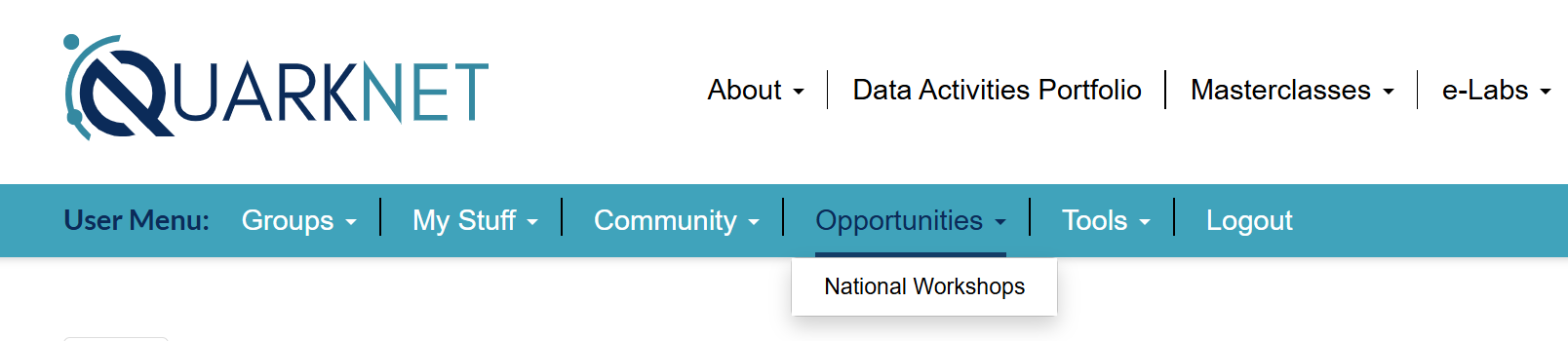
Center leaders: time to plan! Summer workshops are coming up soon. Our mentors and lead teachers have done a good job responding to the RFP and now the next step is to plan dates and activities. To find possible activities or inspiration, you might try the National Workshops page. It had been hard to find in quarknet.org but now if you log in you can see an "Opportunities" button that leads to a link to the page, like this:
We hope that will be more handy going forward. Questions? Ideas to share? Plans partly or fully formulated? Contact Ken, Shane, or Spencer.
About that National Workshops page: We have three new entries, subtly marked, "NEW!" The AI UnWorkshop is a chance to work out together the perils and promise of Artificial Intelligence for our classes. The DAP Workshop is a wide but deep exploration of the Data Actvities Portfolio. As for the third...
CMS Open Data Workshop: There will be a CMS Open Data Workshop with a special emphasis on pedagogical uses at Notre Dame this summer, July 28-30. Teachers can participate in person or online (there is some limited travel funding) or whole centers can meet on those days and participate remotely with mentor assistance: that would make for a pretty great center workshop! Details, including a registration link, can be found here.
Upcoming QED: Mark your calendars for Wednesday, May 20, for the final QED session of the school year. The QuarkNet Educational Discussions meeting will be on Zoom (link; passcode hint "he wrote the book") at 8:00pm EDT and the session will focus on using 3D simulations to reinforce kinematics and dynamics concepts.
Physics Experiment Roundup
We begin today's Roundup with news from the FF Awards Desk: The Muon g-2 pioneers won the Breakthrough Prize for precision measurements of the muon's magnetic moment. Meanwhile, DUNE was named Project of the Year for its massive excavation progress in South Dakota. Next up...Milestones: DESI completed its 5-year mission goal, producing the largest 3D map of the universe (>47 million galaxies and quasars!), while Fermilab delivered the final cryomodule for SLAC's X-ray laser upgrade.
In the Frontiers category: CMS probed quarks down to 10-20 m, finding no inner structure. Researchers are also testing radio wave detection in polar ice to catch high energy neutrinos. Lastly, the Tech & People section: Learn how dilution refrigerators reach near absolute zero in this video, and meet engineer Jacopo Bernardini, who is managing international cryomodule production for PIP-II.
Resources
The AVS (American Vacuum Society) is offering a two-day, free, STEM workshop this coming November with high school-ready lessons that integrate science, math, and engineering using hands-on vacuum technology-based activities. Interested teachers are encouraged to apply by September 18 for sponsorship to attend this workshop. (H/T Maria Niland)
From The Physics Teacher...Looking for a budget-friendly demo? Learn how to build a low-cost Van de Graaff generator using simple materials to demonstrate electrostatic principles in the classroom. Next up, a classroom activity that helps students distinguish between correlation and causation. "Exploring the Impact of the Contemporary Physics Education Project" contains links to several posters that may be familiar to many of you, including Fundamental Particles, Nuclear Science, History & Fate of Universe, among others.
A recent article from APS Physics explores the complex relationship between physicists and Artificial Intelligence. The Perimeter Institute looks at how researchers are working to reduce the perceived “weirdness” of quantum theory by developing deeper explanations of why it works.
Just for Fun
Xkcd tackles the Swiss Army Knife of simple machines...all on one stick! And, why buy a finished product for $80 when you can spend $200 on parts plus ten hours of labor to build a slightly worse version yourself?
For a bit more "fun" (?), consider this recent TPT Fermi Question, "UFOs, Flatland, and dimensional interface phenomena." (They also provide the solutions.)
QuarkNet Staff
Ken Cecire: kcecire@nd.edu
Shane Wood: swood5@nd.edu