

Friday Flyer - November 20, 2026
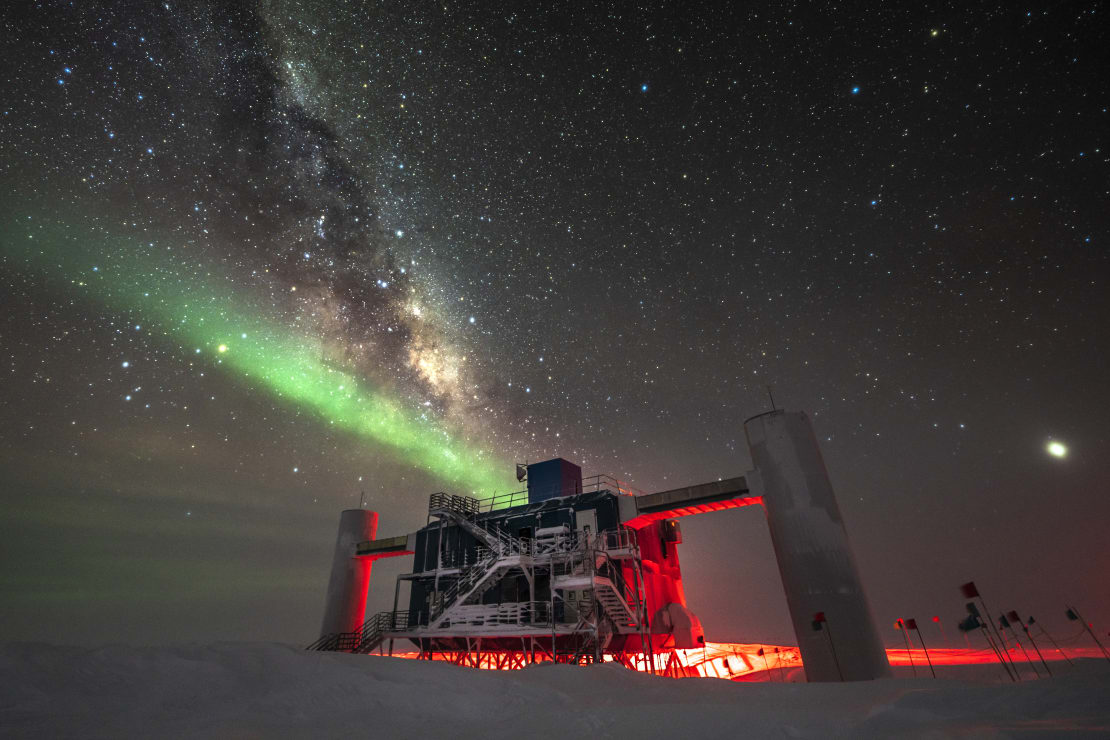
Spotlight on the 2026 Nobel Prize in Physics & IceCube
What can a cubic kilometer of Antarctic ice tell us about some of the most energetic events in the universe? Quite a lot, as it turns out.
The 2026 Nobel Prize in Physics was awarded to Francis Halzen of the University of Wisconsin-Madison for his pioneering contributions to the IceCube Neutrino Observatory and the discovery of high-energy neutrinos originating beyond Earth.
Neutrinos rarely interact with matter. Trillions pass through our bodies every second, largely unnoticed. But these elusive particles carry valuable information about some of the universe's most extreme environments, including regions surrounding supermassive black holes and other powerful cosmic accelerators. Halzen helped turn an idea into reality: using a cubic kilometer of transparent Antarctic ice as a giant particle detector. Buried deep beneath the South Pole, more than 5,000 light sensors are able to detect faint flashes of Cherenkov radiation produced when charged particles, generated by neutrino interactions, travel through the ice faster than light moves through that medium. The observations allow scientists to investigate the origins of high-energy cosmic neutrinos and open an entirely new window on the universe.
Learn more about the 2026 Nobel Prize in Physics and IceCube through the official Nobel Prize announcement, coverage from the National Science Foundation and Physics Today, and the IceCube website. The Nobel Prize website has a nice summary of the science background as well. For ways to connect this into your classroom, check out the related lessons and student activities in the Resources section below.

News from QuarkNet Central
World Wide Data Day (W2D2): A big thank you to everyone who helped make W2D2 2026 a success! This year's event brought together students, teachers, and physicists from all around the world. We appreciate everyone's time, enthusiasm, and contributions. Teachers who had students participate in W2D2 2026: Please complete the brief post-event form by November 30. Your responses will help us accurately document participation and gather valuable feedback to make future W2D2 events even better.
Kavli Institute for Theoretical Physics: Kavli is once again holding its Teacher Day on February 27, 2027, with an optional warm-up workshop the day before. This year's topic: cosmic rays! Learn more at the KITP Teacher Day 2027 site.
International Masterclasses (IMC) 2027: Fermilab-based International Masterclasses will begin February 25 and CERN-based videocons start even earlier. Registration is open! We have an online registration form until December 11 for Fermilab-based masterclasses to be filled out by a single organizer of each masterclass. For all the updates, check out the latest IMC circular.
AAPT Virtual Coffee Hour: The next Coffee Hour will be held on December 7 and will explore the ISLE approach to teaching physics, which emphasizes learning physics by doing physics. This event is open to the public. Click here to learn more and to RSVP.
Center Mentors and Lead Teachers: Mentors should have received an email on Wednesday, November 18, outlining an opportunity for approximately 20 QuarkNet centers to host special STEP UP/QuarkNet workshops during summer 2027. Please review the information and discuss this opportunity with your fellow center leaders, including lead teachers. Contact Shane or Ken with any questions.
Physics Experiment Roundup
Let's start at CERN, where LHCb found evidence of a one-in-ten-billion decay in which a neutral B meson turns into a muon/antimuon pair. The result agrees with the Standard Model and puts tighter limits on what new particles might be out there. At Fermilab, the Short-Baseline Near Detector (SBND) released its first results on how neutrinos interact with argon, a measurement that will help DUNE interpret its future data.
And if our IceCube spotlight has you wondering where else you can put a neutrino detector...How about Lake Superior? (H/T Mike Plucinski) Neutrino detectors can also be found deep underground and can detect geoneutrinos produced by radioactive decay within Earth that may offer new insights into our planet's interior. (H/T Marge Bardeen)
The Voyager 1 spacecraft, traveling for nearly 50 years, has become the first human-made object to reach a distance of one light-day (~26 billion km) from Earth. Read more about it in NASA's official announcement.
Resources
As promised in the Spotlight above, we have some IceCube-related classroom activities to share. First up is Blazing a Trail – Tracking Neutrinos at IceCube, contributed by QuarkNet teacher and Neutrino Fellow Rebecca Jaronski. In this activity, students use real IceCube neutrino data and observations from NASA’s Fermi Gamma-ray Space Telescope to create a sky map and predict possible neutrino sources. You can find Rebecca’s activity in the QuarkNet Teacher Activity Sharespace, a growing collection of classroom resources contributed by QuarkNet teachers. Have an activity of your own to share? We encourage you to contribute using the activity submission form, or contact Shane or Ken with any questions. Note that you must be logged in to QuarkNet.org in order to view the sharespace.
Another IceCube-related activity worth exploring is Name That Neutrino, hosted on Zooniverse, an online citizen science platform where volunteers of all ages contribute to real scientific research. Through Zooniverse projects, students and the public can help scientists make discoveries by analyzing data, classifying images, and identifying patterns. Name That Neutrino offers students an opportunity to participate directly in IceCube research and contribute to our understanding of neutrinos.
Fermilab's Don Lincoln brings us a couple of new videos: "How Long Till We Find a Theory of Everything" and "What's Going On With Fusion?"
Purdue University’s College of Science offers an online collection of videos featuring more than 160 science demonstrations that teachers can use to engage students, illustrate key concepts, and spark classroom discussions. From recent editions of The Physics Teacher: It's Not the Tool, It's the Task and Using Video Games to Teach Kepler's Laws.
Just for Fun
Just in from the Friday Flyer newsdesk: Our xkcd correspondent has an update on the Voyager spacecraft featured in the Physics Experiment Roundup above.
With U.S. Thanksgiving coming up next Thursday, there's plenty of physics to put on the menu. The Department of Energy explains how particle accelerators help make the shrink wrap around your turkey. As the 100th Macy's Thanksgiving Day Parade approaches, Popular Science explores the science and engineering behind those giant helium balloons. And if football is part of your Thursday, NPR tackles a question you can watch for on the next replay: Why does a tight spiral tip nose-down as it flies?
Happy Thanksgiving from all of us here at QuarkNet!
QuarkNet Staff
Ken Cecire: kcecire@nd.edu
Shane Wood: swood5@nd.edu