Friday Flyer - May 15, 2026
Spotlight on the Boston QuarkNet Center
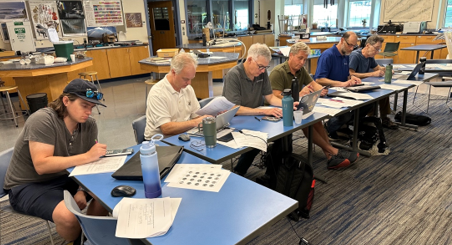
The Boston center is one of our oldest, having started when QuarkNet did in 1999. Amazingly, mentors Darien Wood and Ulrich Heintz are still at the helm, along with lead teacher Rick Dower. And they are still very busy: this past summer the Boston center had a summer workshop focused on quantum physics: Adam LaMee came by to facilitate a pedagogically rich activity with LEDs, and Mike Wadness had the teachers doing quantum activities from the Data Activities Portfolio that he developed for just such workshops.
The center also meets during the school year. The fall meeting was at Northeastern University and featured Northeastern professor Bonilla Castro discussing physics communication, along with issues around the W mass (see below!) and g-2. Rick concluded his series of lessons on the least action principle. In March, the Boston center returned to Northeastern, but this time for their annual CMS masterclass. Coming up: the spring meeting in a few weeks.

News from QuarkNet Central
CMS Open Data Workshop: There will be a CMS Open Data Workshop with a special emphasis on pedagogical uses at Notre Dame this summer, July 28-30. Teachers can participate in person or online (there is some limited travel funding) or whole centers can meet on those days and participate remotely with mentor assistance: that would make for a pretty great center workshop! Details, including a registration link, can be found here.
Upcoming QED: Mark your calendars for Wednesday, May 20, for the final QED session of the school year. The QuarkNet Educational Discussions meeting will be on Zoom (link; passcode hint "he wrote the book") at 8:00pm EDT and the session will focus on using 3D simulations to reinforce kinematics and dynamics concepts.
Center leaders: time to plan! Summer workshops are coming up soon. Our mentors and lead teachers have done a good job responding to the RFP and the next step is to plan dates and activities. To find possible activities or inspiration, you might try the National Workshops page, now available under Opportunities if you are logged into quarknet.org.
Physics Photos: You (just barely) have time to register for the 2026 AAPT High School Physics Photo Contest. The deadline is - ulp - today, so search out those images now.
Physics Experiment Roundup
Let's go right to CERN, where, according to Scientific American, CMS is zeroing in tightly on the W mass. While we are there, ATLAS, not be be outdone, is setting limits on self-interaction of the Higgs and giving us new insights into cosmic rays, as reported in CERN Bulletin. Over at Fermilab, we learn in Fermilab Frontiers that researchers are developing AI tools to advance accelerator physics.
APS Physics has a pair of interesting articles: how to verify quantum entanglement and still looking for a more precise vale of G. (Maybe it is time to try out the Cavendish experiment with your students!)
Resources
We have some ponderable astrophysics - related to particle physics, of course - from APS Physics: an ultrahigh-energy cosmic ray accelerator "out there" and supernovae affected by neutrino oscillations.
What's beyond that? Well, there are, again in APS Physics, the results of a big survey to find the greatest mysteries in physics. It's a big deal: there is a physics mysteries dashboard and a physics mysteries video. Some of the hot topics are the Big Bang, gravitational anomalies, anthropic coincidences, and interpretation of quantum mechanics.
And if you are wondering over the mystery of finding a contemporary physics case for dimensional analysis, the American Journal of Physics has you covered with a dimensional analysis path to h and the Bohr atom structure.
Just for Fun
What is fun? At Fermilab, baby bison is fun. In The Physics Teacher, high speed photos of fluids are fun. At xkcd, board games can be fun and messing around with the periodic table is a regular riot. Here at FF, we like premakes and classic Ealing film loops like 80-231, 80-233, and 80-234, which really do go together. Of course, the real classic is 80-2181, which we keep running. On a loop.
QuarkNet Staff
Mark Adams: markradams74@gmail.com
Ken Cecire: kcecire@nd.edu
Spencer Pasero: spasero@fnal.gov
Shane Wood: swood5@nd.edu