Friday Flyer - October 2, 2026
Spotlight on QuarkNet 2026-27
Welcome back to the 2026-2027 academic year and to the Friday Flyer after our summer hiatus! The editorial offices at One Friday Flyer Plaza are again buzzing with excitement, typing, and, of course, cosmic ray muons. And we do have some news.
First, the tough part. The QuarkNet NSF grant was not renewed this cycle, which means that the base funding for "QuarkNet Central" is no longer available. We will apply for a new grant and look for new opportunities but, right now, things are tight for QuarkNet.
Now the good news: We are still here! ATLAS and CMS in the U.S. continue their support, and Notre Dame has stepped in to help. As a result, we can still have QuarkNet workshops through summer 2027 with stipends. World Wide Data Day and International Masterclasses are still on the agenda as is the Cosmic Ray program. Meanwhile, we are working to secure new funding to put QuarkNet on a more stable footing for 2027 and beyond.
We staff believe the future is bright in part because of what we are learning and planning but mostly because we have talked with so many QuarkNet teachers who show unabated enthusiasm for the program and are doing great things. Mentors, PI's, and our Advisory Board have all been just as supportive. Thank you to every one of you...and stay tuned!
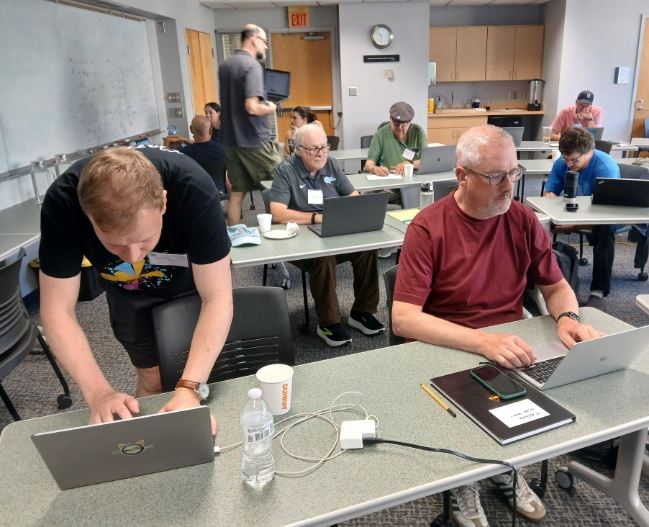
| Geeks at work: One of the highlights of summer 2026 was the CMS Open Data Workshop & Pedagogy Hackathon held at Notre Dame. Our pal Tom McCauley was one of the leaders and it was well-attended by QuarkNet teachers both in-person and online. |
News from QuarkNet Central
World Wide Data Day (W2D2): World Wide Data Day is on November 10 this year and registration is open now! This is a great chance to have an international "mini-masterclass" with authentic LHC data in your school. The time committment integrates to about two hours, soup-to-nuts, up through the November 10, videoconference, which is where your students meet a physicist. Learn more at the W2D2 website (handily, at cern.ch/w2d2) and send questions to Ken or Shane.
Users of the QuarkNet cosmic ray detectors and e-Lab: Even with the changes in the QuarkNet grant for the 2026-27 program year, we want to reassure detector users that Dave Hoppert will continue to provide support for the hardware, and Mark Adams and the Cosmic Ray Fellows will continue to provide e-Lab support. Please feel free to reach out to them with any questions you have.
International Cosmic Day (ICD): Speaking of cosmic rays, November 19 is International Cosmic Day! ICD is an exciting day for high school cosmic ray experimenters all over the world to work together and share results. Learn more and register at the ICD website.
Cosmic Pathways in Chicago and New York: If your school is within striking distance, you may want to bring your students - and yourself - to Cosmic Pathways Chicago on October 17 or to Cosmic Pathways New York on November 7. Cosmic Pathways is a unique Saturday program for high school and undergraduate students and for teachers to mix and learn together about the excitementn of physics. Check those links for information and registration.
American Association of Physics Teachers (AAPT): The AAPT October 2026 eNNOUNCER is out and ready to read! One of the highlights: the final (last, ultimate, no-more-after this) AAPT Winter Meeting in January 2027. Registration is open (with an early-bird discount until October 23) and you can still submit a poster abstract.
There's more! AAPT is forming a AI Leadership Working Group and is looking for ten educators for a one-year action research project. The kickoff is at the Winter Meeting in New Orleans and acceptance includes support to attend. Find out all about it and apply!
Kavli Institute for Theoretical Physics: Kavli is once again holding its Teacher Day on February 27, 2027 with an optional warm-up workshop the day before. Once again: cosmic rays! Learn more at the KITP Teacher Day 2027 site.
International Masterclasses (IMC): The long ramp-up to IMC 2027 begins today with the second IMC circular. (Here is the first circular.) Note that we start early this year: QuarkNet Fermilab-based videoconferences begin February 25 and CERN videocons start even earlier.
Physics Experiment Roundup
We've read some interesting items in CERN Bulletin. To start, the long LHC shutdown has begun to get ready for the High Luminosity LHC, upgrade detectors, repair radiation damage, and fix what needs fixing. The LHC closed strong, with ATLAS and CMS finding evidence of entangled Z bosons. And the hunt for dark matter continues with NA-64. Returns form the HL-LHC is will come not only in physics research but also in the economy: that is worth watching. Looking for more CERN or LHC news? You can start with The Cylindrical Onion, the CMS blog, and sign up for the CMS newsletter, Point Cinq.
Interactions.org gives news on other fronts. If you are a muon collider fan, you find it interesting that J-PARC in Japan is working on a different sort of muon accelerator and has begun experiments that acclerate cooled muons. On the dark matter front, we have interesting neutrino news from XENONnT at Gran Sasso in Italy and, at SURF in South Dakota, LUX-ZEPLIN saw a signal.
What about Fermilab? Well, the SQMS Center has made a significant discovery in understanding qubits and the g-2 experiment has some new results for the muon electric dipole moment.
Resources
Thinking about forming a Beamline-for-Schools (BL4S) team? Maybe you can take and share inspiration from this CERN Bulletin article on students going to CERN, DESY, and the University of Bonn.
Thinking about AI? Who isn't? MIT certainly is with this Report on AI and Education and Effective Prompts for AI: the Essentials. Worth reading!
Perhaps you are just thinking of learning a bit more. The Physics Teacher comes to help with Did We Find the Real Higgs Boson? by our friend Don Lincoln and Triangles at the Speed of Light: The First Relativistic Drawing. The triangle approach is pretty sound for understanding Lorentz Transformations, as seen in this QuarkNet tutorial. And, in American Journal of Physics...AI again.
Check it out: The PhysTEC Physics Teacher Community Guide is a collection of national networks, low-barrier professional growth opportunities, and actionable tips for starting or connecting with a local physics educator community.
We'll finish this section with a video slice of life and work at Los Alamos National Lab. (H/T Danielle McDermott.)
Just for Fun
AI is, as mentioned above, on our minds. So we ran an experiment right here at FF. We tried a single prompt on several agents: Please make a joke about muons. Here is what we got...
Google Gemini: Why did the electron break up with the muon? Because the muon was way too high-maintenance, always living fast, and collapsed after just 2.2 microseconds! (Or, as I.I. Rabi famously put it when the muon was discovered: "Who ordered that?")
Grok: Why did the particle physicist refuse to date a muon? Because he knew any relationship with one would be extremely short-lived.
ChatGPT: Why did the muon get invited to every party? It was always passing through!
Claude: Why don’t muons ever get invited to parties? Because they’re too short-lived—they never stick around long enough to have fun!
Well, particle physics comedy writing is apparently one occupation AI is unlikely to take over soon.
To make up for those, we have xkcd, xkcd, and, since it is now autumn, xkcd.
QuarkNet Staff
Ken Cecire: kcecire@nd.edu
Shane Wood: swood5@nd.edu