QuarkNet @ KITP - Particle Physics: At the Heart of Matter
Friday, 3 April, 2026 9:00 AM - 4:30 PM PT
UC Santa Barbara, CA
Small URL for this page: https://tinyurl.com/QNatKITP26
Agenda
| Time (PT) | Activity |
|---|
| 9:00 AM | Greetings and introductions (Shane and Ken) - Whip around for introductions
- Name
- School name and state
- What is QuarkNet?
- Setting the stage: Big to small (slides)
- How can we bring contemporary physics into our introductory physics classroom?
|
| 9:30 AM | Activity: Shuffling the Particle Deck (Ken and Shane)
Explore the elementary particles that make up the Standard Model. |
| 10:00 AM | Activity: Quark Workbench (Joel)
Discover rules of nature via induction based on how quarks fit together to form mesons and baryons. |
10:45 AM | COFFEE BREAK |
| 11:00 AM | Tour of the Data Activities Portfolio (DAP) (Ken) Jigsaw DAP activities based on interest. Each group will share out a summary of the activity and some possibile implementation ideas after lunch. (Shane) Activities - Each participant joins one group: - Calculate the Z Mass - Nicole
- The Case of the Hidden Neutrino - Jeremy
- Use momentum conservation to examine the decay of top-antitop pairs to determine what is missing from the event.
- Level 1
- TOTEM 2 - Charlie
- Use quantum physics and LHC data to estimate the size of the proton.
- Level 2
- Rolling with Rutherford - Tugs
- Use statistics to make an indirect measurement.
- Level 1
- Making it Round the Bend (Qualitative, Quantitative) - Joel
- Explore the effects of electric and magnetic fields on particles and use online animations that show how charged particles can be accelerated and their paths deflected
- Level 1 (Qualitative) and Level 2 (Quantitative)
|
12:15 PM | LUNCH (provided) |
| 1:00 PM | DAP Activity Share-out - Each group will share out a summary of the activity and some possibile implementation ideas.
LINK TO PICS OF IMPLEMENTATION PLANS- Calculate the Z Mass
- The Case of the Hidden Neutrino
- TOTEM 2
- Rolling with Rutherford
- Making it Round the Bend (Qualitative, Quantitative)
- Overall implementation discussion and Q&A
*Kathy Race will join via Zoom*
|
1:45 PM | Particle Accelerators Tutorial (Ken and Shane) - Divide into 6 groups. (Two groups per question on tutorial.)
- Each group should answer the Foundation Question plus one of the three Group questions.
- Each group should prepare to present to the other groups what they have learned.
|
| 2:30 PM | Quantitative Modeling Using PET Imaging and Analysis |
| 3:00 PM | BREAK: Coffee & Cookies - with Quark/Gluon physicists |
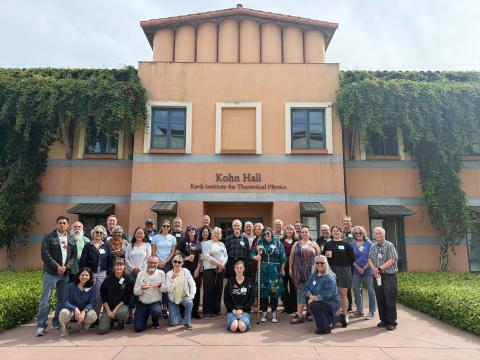
3:30 PM | Group Picture - out front |
3:40 PM | Preview Activities for Saturday's Conference - Flavio Fenten, Georgia Tech
|
| 4:30 PM | End of workshop - Return to hotel for 5:00 PM Social |
Contacts
Workshop description:
Students who complete an introductory physics course may come away with the impression that physics largely ended in the early 20th century, when in fact it remains a vibrant and evolving field. Today’s physicists continue to investigate fundamental questions—such as the nature of dark matter and dark energy and the imbalance between matter and antimatter—often through large-scale international experiments like those at CERN. This workshop explores how teachers can use examples from contemporary physics to motivate students and provide modern contexts for core topics and practices in introductory physics, including conservation laws, data collection and analysis, and evidence-based reasoning. Participants will alternate between “student mode” and “teacher mode” as they analyze authentic experimental data and work through selected activities from QuarkNet’s Data Activities Portfolio. The workshop concludes with a discussion of classroom implementation and includes a brief preparatory session for Saturday’s conference on the physics of biological systems like the human heart. Some activities are computer-based; please bring a laptop.